
Compare details with the original.
Check the proposed person and medication information against the actual source. A prepared draft is a starting point for qualified verification.
Medication-document review · Human verification
Inspect proposed medication details against the source document and review the recorded findings. Qualified staff verify the information and handle clinical decisions through the appropriate workflow.
People verify the facts, review AI drafts and approve consequential actions.
Book a 30-minute compliance demo30 days free · Then $20 USD per person supported per month.
$0 setup for system initialization · Month-to-month · No long-term contract
Migration scope and costs are separately agreed.
The work behind the decision
The review must establish whether the proposed details reflect the document and which findings remain unresolved. Extracted fields or an automated review result are not clinical authorization.
What your team can evaluate
Check the proposed person and medication information against the actual source. A prepared draft is a starting point for qualified verification.
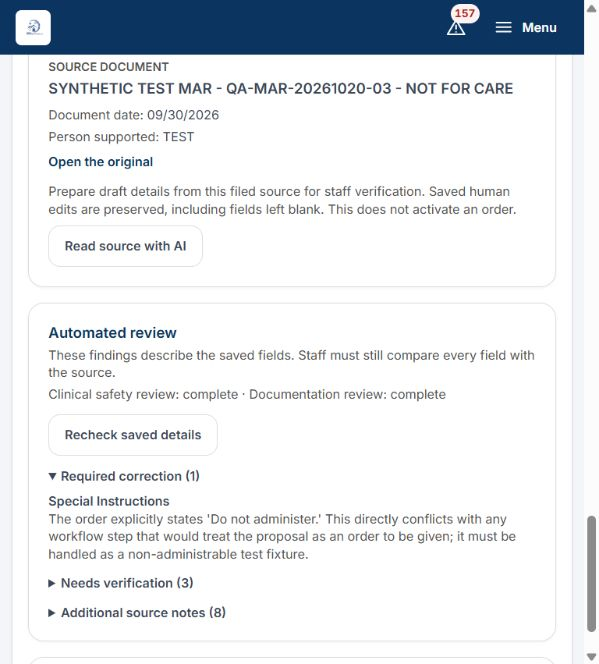
The synthetic screen shows automated review findings and a Do not administer instruction. The finding requires staff verification; it is not a completed clinical decision.
The displayed fixture remains a test document. It does not prove an activated order, a completed medication pass, a signature or a safe administration outcome.
What to examine
The source is explicitly a synthetic test MAR. The screen shows review findings for verification, including the Do not administer instruction. It is a supporting example of human review, not a clinical approval or a completed medication workflow.
A practical evaluation
Use synthetic information to check what the proposed record contains.
Review the source and the items needing verification with the appropriate staff role.
Before relying on an operational medication process, verify permissions, required review, order activation and administration steps in the agreed scope.
Confirm workflow availability, required approvals and the connections available for your agency. Nationwide service does not establish universal state or payer coverage.
Questions before the next step
The displayed synthetic review does not establish order activation or clinical approval. Authorized staff must follow the relevant operational workflow.
No. A documentation gap needs investigation. Qualified staff determine what happened and take the appropriate action under the order and agency process.
No. Staff must compare proposed details with the source. The synthetic example is not an accuracy benchmark or a guarantee of clinical completeness.
A focused demonstration
Use the synthetic review example to inspect proposed details, review findings and the verification boundary with your team.
Book a 30-minute compliance demoUse sample data. No patient records needed for the demo.